

On 29 August 2022 during a speech delivered in Prague, German Chancellor Olaf Scholz announced the European Sky Shield Initiative (ESSI). Eighteen months later, first analyses suggest mixed reactions and feelings of incompleteness. While Gerald Ford may be rarely cited in the Dictionary of Quotations, he once coined a phrase that rang true when he spoke of the impossibility of successfully executing a bad plan. Less radically, it could be said that an imperfect plan is bound to be imperfectly executed.
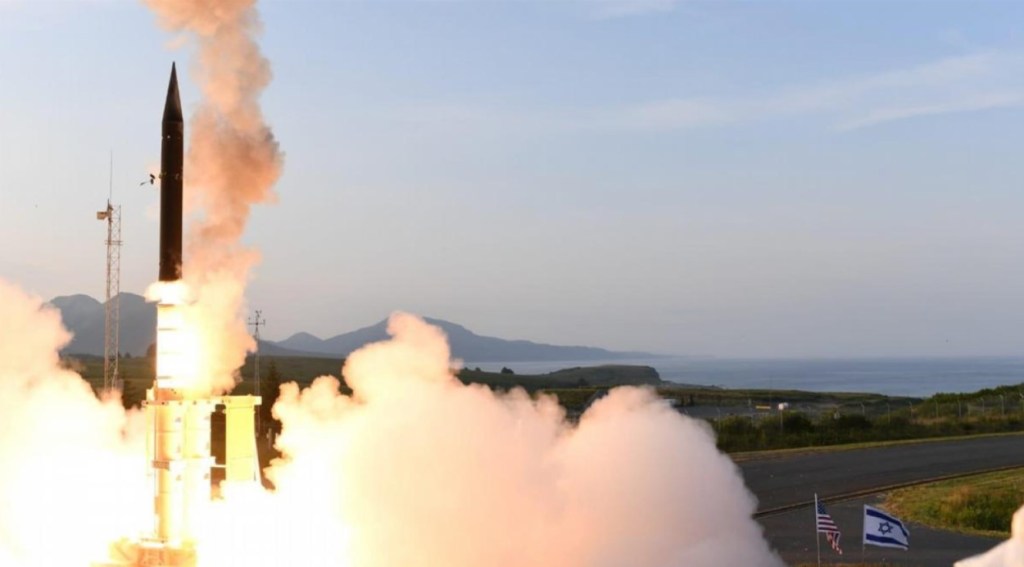

An example of the major questions begged by the German Sky Shield Initiative (photo above of Israel’s Arrow 3 system) is the use of the adjective ‘European’ to qualify a missile defence system to which 15 EU and/or NATO European members have so far failed to subscribe. (Jean-Paul Palomeros and Denis Verret) (Photo credit: Handout)
Europe needs a missile defence system
There is no denying that missile defence is of growing strategic importance, if only because of Russia’s incessant strikes against Ukraine, the recent Hamas attacks on Israel or the still more recent barrage of drones and missiles launched by Houthi rebels in the Red Sea. It is also important to pre-empt the risk of potentially hostile States or pseudo-States developing their drone or missile capabilities. If not only the latest hypersonic missiles but also drone swarms and Lethal Autonomous Weapons Systems (LAWS) are added to the mixture, the extent and complexity of the necessary air and missile defence systems is even more apparent.
Since a permanent member of the UN Security Council and one of the world’s major powers declared war on Ukraine, Europe has had to face the very real risk of high-intensity warfare spilling over into the continent and has been forced into finally addressing the long avoided issue of a European anti-missile defence system. While NATO’s Integrated Air and Missile Defence system may offer a first line of defence against ballistic missiles, it is limited in scope and basically targets threats to the southern fringe of the Alliance.
In any discussions on a European missile defence system, it will, however, be necessary to factor NATO’s nuclear capabilities into the equation, together with those of France and United Kingdom, both nuclear powers. Against this backdrop, it will therefore be vital to strike a balance between legitimate demand for anti-missile systems and a rash and headlong rush to develop an antimissile shield akin to that proposed by Ronald Reagan in his Strategic Defence Initiative (SDI).
Unanswered questions
Reverting to the German initiative, Germany’s skills in persuasion have clearly been quite effective, since 18 European countries have, in principle, come on board. By October 2022, Belgium, Bulgaria, the Czech Republic, Estonia, Finland, Hungary, Latvia, Lithuania, the Netherlands, Norway, Slovakia, Slovenia, Romania and the United Kingdom (as an observer) had subscribed to the initiative, followed by Denmark and Sweden in February 2023 and Austria and Switzerland in July 2023, If Germany has been able to convince so many potential partners, it is largely because it has long subscribed to the NATO Framework Nation Concept (FNC) first mooted by the Alliance in 2014. But, if Germany’s ambitious plans are to succeed, there are a number of as yet unanswered questions that will need to be addressed.
One of the main issues raised by this initiative concerns the use of the word ‘European’ to qualify a missile defence system that does not have the support of 15 European EU and/or NATO member countries, which are not prepared to subscribe to the proposal as it stands (France,Italy, Spain, Poland, Portugal, Greece, Croatia, Cyprus, Ireland, Luxembourg, Malta, three other NATO member countries in the western Balkans plus the United Kingdom as an observer at this stage).
A second issue, closely linked with the first, is that of whether prior consultations were conducted within NATO, notably with Europe’s nuclear powers. It is important to ensure that conventional capability developments should be consistent with those of nuclear deterrent, Ballistic Missile Defence (BMD) and Deep Strike capabilities if they are to suffice to deter potential assailants. The question also arises as to whether sufficient allowance has been made for the key factor of interoperability required of all air defence projects.
As things stand today, it is not clear whether the Arrow 3 system purchased last September by Germany from Israel Aerospace Industries (IAI) for 4 billion euros forms an integral part of NATO’s Integrated Air & Missile Defence (IAMD), this being a condition sine qua non for the exo-atmospheric missile interceptor system purchased by Germany to be fully effective. For the moment there is no European equivalent, a situation likely to continue in the absence of plans to develop a European system.
A further major issue concerns the fact that the German initiative only offers German short-range (notably IRIS T), American mid-range (Patriot) and Israeli long-range (Arrow 3) missile solutions, ignoring the alternative European options available in the short to medium term. Examples are the existing systems and European projects of MBDA, a multinational company born of the merger of UK, French, Italian and, in part, German tactical missile development capabilities, and also a flagship example for the many possibilities offered by European defence industry cooperation. MBDA represents 80% of Europe’s tactical missile capabilities and is therefore able to compete on an equal footing with American giants such as Raytheon, Boeing or Lockheed Martin.
By ignoring European options, the German initiative is in stark contradiction to the common objective of the Strategic Compass unanimously adopted by the 27 EU Member States in March 2022. The Compass particularly advocates strengthening Europe’s industrial and technical base to attain a degree of strategic autonomy, thus also contributing to NATO reinforcement.
Feelings of unease
These unanswered questions are the source of misgivings that only serve to highlight the limitations of the German initiative:
- Why did only ten of the 16 NATO ally countries subscribing to the initiative sign the MOU on 11 October in Brussels (memorandum of understanding to further develop the European Sky Schield Initiative [ESSI]), namely Germany, Belgium, Czech Republic, Denmark, Estonia, Hungary, Latvia, Lithuania, the Netherlands and Slovenia and why did Bulgaria, Finland, Norway, Slovakia, Romania and the United Kingdom (observer) fail to sign?
- Admittedly, Romania has joined forces with Germany, the Netherlands and Spain, which have already procured Patriot systems, in placing an order for 1,000 new generation Patriots (GEM-Guided Enhanced Missile) for the sum of 5.5 billion dollars via the NSPA (NATO Support and Procurement Agency). The supplier, COMLOG, is an MBDA Germany/RTX (ex-Raytheon) Joint Venture. It is also expected that MBDA will partner Israeli manufacturer IAI for ARROW That said, MBDA Germany’s Managing Director, Thomas Gottschield, still maintains that his “main objective remains European cooperation”.
- Another noteworthy factor is that some of the 19 countries currently subscribing to the initiative have nevertheless opted in favour of European procurement solutions not featuring on Germany’s shopping list: Belgium, Hungary and Estonia have chosen the Mistral very short-range air defence systems as Norway, Finland and Austria did before them. For short-range systems, the United Kingdom has opted for the Common Anti-Air Modular Missile (CAAM) as has the Swedish Navy. Mention should also be made, since it is more than relevant to the issue at stake here, of the very recent Franco-Swedish declaration on a new strategic partnership, in which the two countries underlined their common desire to extend their cooperation in the air defence and surveillance sector in a bid to ward off future threats. Another point worth mentioning is that Denmark and Lithuania have decided to procure the Thales GM 200 (Ground Master 200) air defence radar rather than the German Hensoldt system generally used with IRIS T, a choice also made by the Netherlands and Norway. Last but not least, Finland recently decided in favour of another Israeli high-altitude interceptor system to the Arrow 3, namely the Rafael and Raytheon David’s Sling.
- Surely it would be wiser not to decide in advance on solutions without waiting for feedback from the air and missile defence systems deployed in Ukraine, the Israeli systems countering the blanket missile attacks launched by Hamas or the anti-drone and antimissile systems in operation in the Red Sea? The following list is not exhaustive but systems in use include MBDA’s very short-range Mistral, short-range VL-Mica or mid-range Mamba or the NASAMS (National Advanced Surface- to-Air Missile Systems) produced in America and Norway. Why are none of these systems included in the German initiative’s shopping list in addition to Germany’s choices of IRIS-T, Patriot or Arrow 3?
- A further sign of the unease caused by the German initiative is the fact that the European Commissioner, Thierry Breton, failed to mention it at the 3rdEuropean Defence and Security Conference on 13 October last when he highlighted European Defence Fund (EDF) support for the technological development of two hypersonic interceptor systems, which he described as “all bricks that could constitute, when the time comes, the bases of a real European air and missile defence shield – a Eurodome.
- Given the obvious failings of the ESSI initiative in terms of both scale and approach (areas of Europe to be protected and threats to be countered) and the lack of allowance for European solutions capable of responding to these needs, in mid-June 2023 France organised a European Air and Missile Defence Conference to coincide with the Paris Air Show. The aim of this conference was to make the Europeans aware of the need for a more strategic and forward-looking approach to the continent’s air and missile defence systems. By working together, it should ultimately be possible to establish common operating requirements and capabilities in relation to the desired degree of European autonomy. The Conference ended on a proposal to hold similar events in the United Kingdom and Italy (scheduled for March 2024) as well as in Germany (which still has to fix a date). Promising although all this may be, Germany seems unlikely to change its mind over the solutions selected, despite German Minister Boris Pistorius’ repeated insistence on the open status of the initiative. If this were true, other options should still be possible. But for an initiative to be “open” potential partners cannot be told, as some already have, that they have to “take it or leave it” or should “get out of the way”!
- As announced, the United Kingdom hosted the 2nd Conference in early September 2023 to coincide with Defence & Security Equipment International (DSEI) in an attempt to resolve the situation via a top-down approach. In addition, it recently sent the other European countries the draft of a LOI baptised DIAMOND, apparently with the twofold objective of ensuring that due allowance be made for all air and missile threats facing the continent and the full range of European solutions capable of countering these threats in the short, medium and long term.
Top-down approach
A top-down approach is vital for ascertaining requirements in relation to current and foreseeable future threats, agreeing priorities, identifying solutions and embarking on projects with the potential to meet the comprehensive and integrated air and missile defence challenge. It is equally vital to remain realistic in these times of scant financial resources and to make maximum use of available funds by pooling efforts to build up the European DITB, which can already offer tried and tested and ever expanding capabilities.
Jean-Paul Paloméros and Denis Verret
5 February 2024