

Introduction
„Few ideas appear with such regularity in discourses about European defence as the “European army” (Franke, 2024).


Cpl. First Class Leon Berkepeis of the Netherlands, center, with German soldiers of Tank Battalion 414 (Bennhold, 2019). The first example of an European Army?
With the Russian Invasion of Ukraine, the question of how to ensure European Security remains largely unanswered. As it appears that Russia will not back down from it´s maximalist war aims in Ukraine, European Countries are still looking for an adequate response. Looking beyond this conflict, the Republican Nominee for the Election of 2024, Donald Trump, has already proven to be an unreliable ally, at one point even suggesting that Russia should attack NATO if Allies that are not paying their share (Sullivan, 2024). Especially this position might throw the future of the Transatlantic Alliance out of balance, which would leave Europe to fend for itself. Therefore, Leaders in European Countries are looking for ways to ensure the safety of Europe. Acutely aware of this, President Macron of France recently argued that the rules of the game have changed and that „Europe is mortal“ (Tidey, 2024).
This article aims to discuss whether or not a European Army would be able to meet the demands that Europe has regarding it´s defence and security needs. Before that, the author talks about the current understanding of Europe as a Civilian Power and what a European Army would actually mean. Looking back at Macron`s comments regarding the mortality of Europe, this paper concludes with a short discussion if this idea has the potential to answer the security and defense needs of the EU.
1. The EU as a Civilian Power
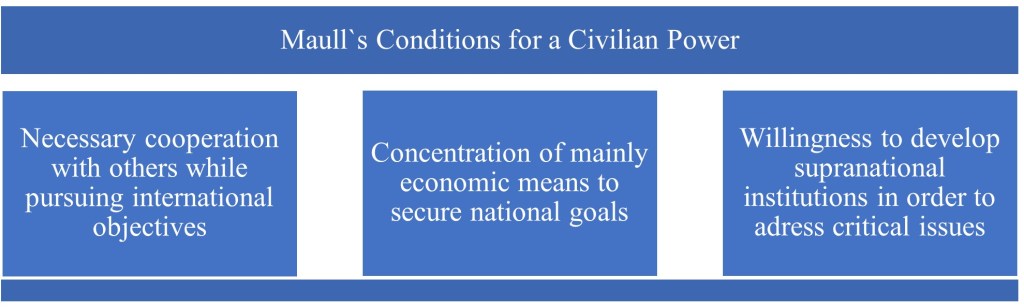
Usually, the European Union is referred to as a „Civilian Power“. Observers agree that there is a difference between military and civilian means (Smith, 2005). Civilian means non-military and includes economic, cultural and economic policy means. Military means to usually involve armed forces (Smith, 2005). Sometimes, the distinction between the two is fuzzy, for example, peacekeeping forces are referred to as a civilian foreign policy instrument. In order to properly describe what a civilian power is, Hans Maull considered three elements (Smith, 2005, P.4 quoted after Maull, 1990, P.92-3):

2. The European Army – Definition and Obstacles
The European Army is an approach to European Security that has been going around since the 1950s. Then President of the European Council, Rene Pleven, proposed it for the first time (Pleven, 1950). In the past, the French-German Axis argued in favour of this proposition, with Macron saying in 2018 that „a real European Army“ should established (Gros-Verheyde, 2018). Days later, the then Chancellor of Germany, Angela Merkel, joined Macron and argued that a vision for a European Army should be established. Other leaders, like former European Commission President Jean-Claude Juncker, mentioned it as well (Euractiv, 2015).
The term „European Army“ is in itself quite ambiguous. It means to inspire and can be interpreted as being close to Barack Obamas idea of the „United States of Europe“ (Franke, 2018). In 2019, Germany and the Netherlands formed Tank Battalion 414, which was then described as an informal test case for a broader cooperation, since it was the first battalion that was consisted of soldiers from two European Nations (Bennhold, 2019).
Regarding how a European Army would look like, two options are usually presented. One option includes that each state could disband its forces, in order to put its military strength into a larger, common super-force. The other option is that member states could offer up a chunk of resources to a common pool, similar to how NATO functions (Cook, 2024).
However, these two options still face obstacles that make a European Army unlikely to become a reality in the future. One of the obstacles for a potential European Army is political will. Political Will is defined as: „the extent of committed support among key decision makers for a particular policy solution to a particular problem“ (Post et al, 2010). Since defence is regulated nationally, Europe does not have single-headed leadership or a single commander-in-chief, something an Army would require. Language barriers would present another problem as well, since European Countries do not communicate in the same language (Zandee, 2024).
Another obstacle are the domestic politics of the Member States. Four Members, Austria, Ireland, Malta, and Cyprus, are, according to their own domestic laws, not able to join military alliances and are supposed to remain neutral. Domestic politics present another obstacle since different countries have different laws about troop employment. Germany has a „parliamentary army“ means that only a two-third majority of the Bundestag can decide about deployment, as paragraph §115 defines. France, on the other hand, has a „presidential army“ meaning that the president serves as commander-in-chief of the army, as defined in Article 15 of the French Constitution.
An additional obstacle presents itself in the form of the current EU Decision-making Process. When another informal group wants deployment of troops in one area, another group might simply veto it. As for now, unanimity is required to solutions on the EU-Level. This obstacle might can be resolved by changing the decision-making Process and a majority rule could be established (Franke, 2024). However, if something like that would occur, countries that do not wish to deploy troops would be forced deploy them anyway, risking that they would be wounded or killed despite opposition towards a problem (Franke, 2024).
4. Conclusion
This article had the aim to examine whether a European Army could meet the security needs of the European Union. After considering the obstacles a European Army would face, it seems unlikely that such an idea is ever going to gain any traction. Language barriers and especially domestic laws regarding neutrality and the differences in command structures, see parliamentary and presidential army in Germany and France make the idea unattractive. Another barrier mentioned is that a European Army would decide over the life and death of soldiers that belong to countries that might oppose that conflict. For those reasons, the author considers the actual establishment of a European Army unlikely. Despite that, the idea of the European Union as a civilian power can be described as outfashioned, considering increasing multipolarity in world affairs.
In the Introduction, reasons for a higher investment in European defence were made clear. Might it be another Trump Term or continuing Russian Aggression, the necessity for a European Union that deter threats and defend its citizens becomes increasingly obvious. A European Army, however, is not going to be part of that. The Member States should concentrate on increasing defence cooperation between each other, defence programmes like the Permanent Structured Cooperation (PESCO), introduced in 2018, aim to do exactly that.
Even without a European Army, the Union must start to think about its security without relying on others. As Chancellor Merkel put it in 2018: „The times in which we could completely depend on others are, to a certain extent, over. I’ve experienced that in the last few days. We Europeans truly have to take our fate into our own hands“ (Henley, 2018).
By Jonas Pfeufer
Jonas is interested in challenging environments where he can learn and expand his knowledge about global politics. His main academic interest lies in German and European Foreign and Security Policy. He is also very interested in the Politics of European Migration. He moreover worked on projects focussing on Germany’s Role in the EU and Energy Security.
